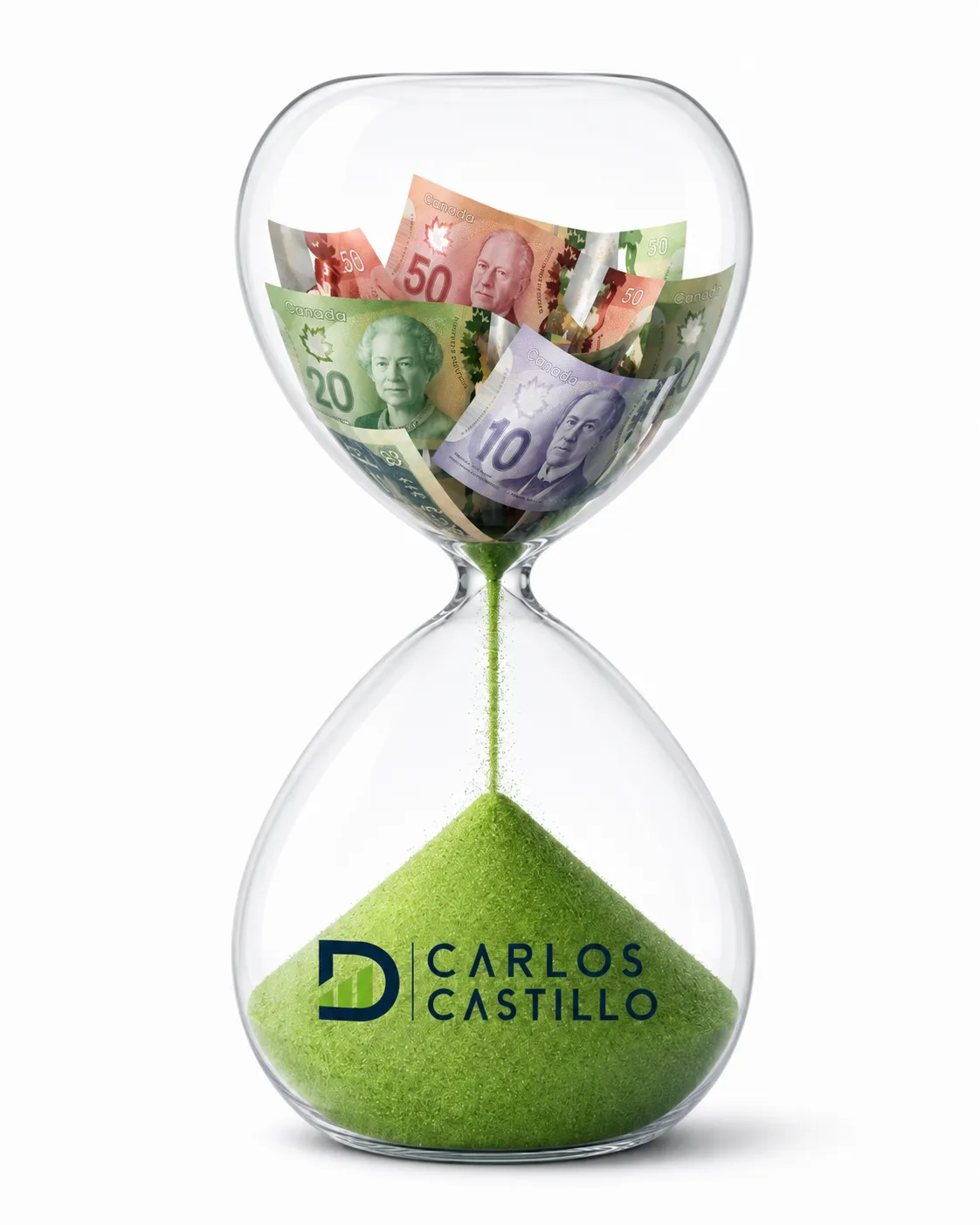
Most Canadians save money. Few actually build wealth. The difference isn't how much you set aside each month — it's where you put it. And that detail, ignored for years, can quietly cost you thousands along the way.
If you're contributing to your TFSA, your RRSP, or you're just starting to think about retirement in Canada, this guide is for you.
The Costliest Mistake: It's Not How Much You Save, It's Where
The biggest retirement planning mistake isn't the amount you set aside each month. It's where you decide to put it. Two people can save the exact same amount over 20 years and end up with very different results, simply because one used Canada's registered accounts strategically and the other let their money sit in a regular savings account.
A traditional bank account offers no tax advantage: the interest it earns gets added to your taxable income every year. Registered accounts — TFSA and RRSP — exist specifically to change that equation.
TFSA and RRSP Aren't Just "Savings Accounts"
The TFSA (Tax-Free Savings Account) and the RRSP (Registered Retirement Savings Plan) are tax strategy tools, not simple boxes to store money in. Each one solves a different problem: the TFSA gives you flexibility and 100% tax-free growth; the RRSP reduces your taxable income today and defers tax until retirement, when your tax rate is typically lower.
We cover when each one makes sense in detail in our guide TFSA or RRSP? Which to Choose When Starting Your Financial Life in Canada. What matters here is understanding that neither one is optional within a serious retirement strategy — the question isn't "which one do I use?" but "in what proportion, given my situation?"
Official Government of Canada information on pension and retirement income planning:
Canada.ca — Public Pensions (CPP and OAS)
The Real Cost of Waiting: Compound Interest and Time
Compound interest rewards time more than it rewards the amount you contribute. Carlos often explains this to clients with a simple geometric progression exercise: a dollar that doubles every year can pass $1,000,000 after just 21 doublings. It's a purely pedagogical exercise — no real investment doubles every year or guarantees that outcome — but it illustrates something real: every year you delay starting your strategy isn't just a year lost, it's a year of potential growth that doesn't come back.
This is the opposite of what a lot of people assume. It's not "I'll save more once I earn more." It's that time inside the right account works in your favor from day one.
Why a "One-Size-Fits-All" Strategy Doesn't Work
The key isn't simply saving more money. It's making sure your money is working as hard as you are. And that looks different depending on who you are:
- Incorporated professionals and business owners have additional tax tools a traditional employee doesn't have.
- Families with a mortgage need to balance paying down debt with growing their registered accounts.
- Newcomers to Canada often don't realize they've been accumulating TFSA room since becoming residents, or how to declare assets held in their home country.
- Young professionals have the most valuable asset of all — time — and tend to underestimate it.
A generic plan ignores all of these differences. A personalized strategy starts by understanding your actual situation before recommending anything.
Unregistered vs. Registered: The Tax Impact
This is the comparison that surprises Carlos's clients the most the first time they see it:
| Feature | Unregistered account | TFSA / RRSP |
|---|---|---|
| Growth taxed every year | Yes, added to your taxable income | No — tax-free (TFSA) or tax-deferred (RRSP) |
| Reduces taxes today | No | RRSP does; TFSA doesn't, but withdrawals are tax-free |
| Withdrawal flexibility | High, no special rules | High for TFSA; penalized for early RRSP withdrawals |
| Best for | General-purpose money, no tax goal | Retirement goals and long-term tax efficiency |
💡 Carlos's Advice
The key isn't simply saving more money. It's making sure your money is working as hard as you are. That's why I help clients build personalized retirement and wealth strategies based on their goals, not a one-size-fits-all approach. Book your complimentary financial consultation and let's review your situation together.
Frequently Asked Questions (FAQ)

About Carlos D. Castillo
With over 30 years of experience in the insurance industry and more than a decade practicing professionally in Canada, Carlos D. Castillo helps families, professionals, and business owners better understand their financial planning options. His approach is primarily educational: the goal is to help each person make informed decisions.